

If you are asking is sitemap important for SEO, the answer is yes. A sitemap can help search engines discover and crawl important pages on your website. This is especially useful for large, new, or complex websites. However, a sitemap does not directly improve rankings.
It also does not force Google to index every page listed inside it. Google describes sitemaps as a way to provide information about important pages, videos, images, and other files. Search engines can use that information to crawl a website more efficiently.
The easiest way to understand a sitemap is to look at where it fits in search:
Page exists → Discovery → Crawling → Indexing → Ranking
A sitemap mainly supports discovery and crawl management. The page itself still needs to deserve indexing and rankings.
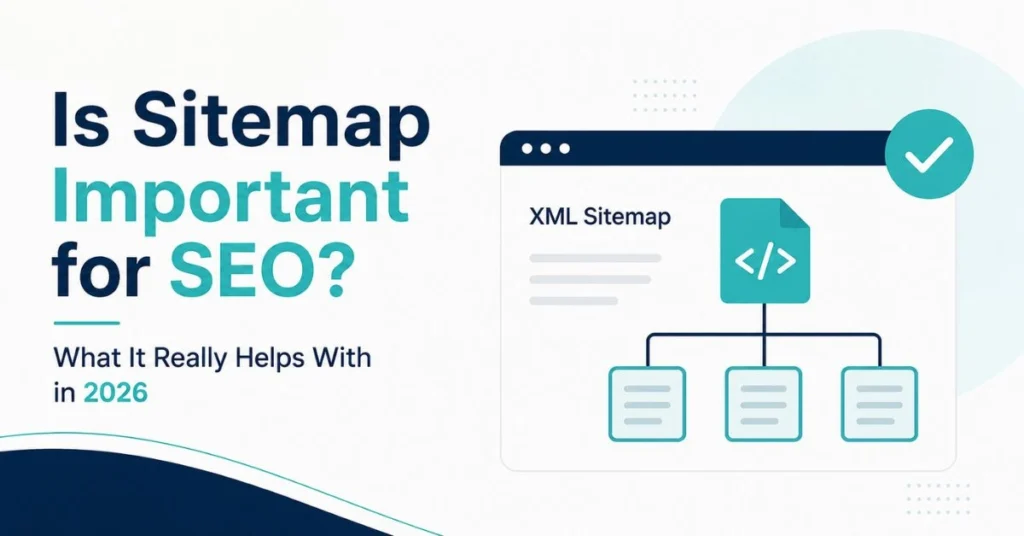
What Is a Sitemap?
A sitemap is a file that provides search engines with information about important URLs on your website. It can also describe relationships between pages and other files. Search engines can use this information during crawling.
A sitemap can contain information about:
- Webpage URLs
- Last modification dates
- Images
- Videos
- News content
- Alternate language versions
There are different sitemap formats. However, XML is the format most website owners mean when they discuss SEO sitemaps. XML sitemaps can also carry more information than a simple text sitemap.
What Is an XML Sitemap?
An XML sitemap is a machine-readable file designed mainly for search engines. XML stands for Extensible Markup Language. You do not need to understand XML programming to use one. Most modern content management systems generate the file automatically.
A common sitemap URL may look like:
example.com/sitemap.xml
WordPress SEO plugins often use a sitemap index instead:
example.com/sitemap_index.xml
The file gives crawlers a clean list of important URLs. Google can then use that list as another way to discover your content.
XML Sitemap vs HTML Sitemap
An XML sitemap and an HTML sitemap have different main audiences. XML sitemaps are designed primarily for search engines. HTML sitemaps are normal webpages created mainly for visitors. Both can support a better website structure.
An XML sitemap can support URL discovery and technical SEO monitoring. An HTML sitemap can help users navigate a large or complicated website. Both can be useful, but they are not the same thing.
For most SEO discussions, XML sitemaps deserve more attention.
Is Sitemap Important for SEO?
Yes, a sitemap can be important for SEO because it helps search engines discover URLs. It is particularly useful when important content is not easy to find through normal crawling. It can also help search engines understand the preferred URL inventory of a website.
But a sitemap is not a direct ranking factor.
Google explains that a sitemap can help it learn about a website. However, having one does not guarantee indexing or higher rankings.
This is an important distinction.
A sitemap tells Google that a page exists. It does not tell Google that the page deserves position one.
Does a Sitemap Improve Google Rankings?
A sitemap does not directly improve organic rankings. Adding /sitemap.xml will not suddenly move a page from position ten to position four. Rankings depend on many other factors. The page itself still needs to compete successfully.
For example, a page needs to satisfy search intent. The content should be useful and relevant. Internal linking, technical accessibility, authority, and other SEO factors also matter.
A weak page and a strong page can both appear inside the same sitemap. The sitemap simply exposes both URLs to search engines. It does not make the weak page equal to the strong one.
The same idea applies to other technical SEO features. Structured data can improve search appearance without directly increasing rankings. Our guide on whether rich snippets help SEO explains that distinction in more detail.
If your pages are already being discovered but still perform poorly, the sitemap may not be the main issue. Broader On Page SEO Optimization may deserve more attention.
A sitemap is also only one part of a wider search strategy. If you are unsure which SEO issue should come first, our guide on what is the best strategy for SEO explains how to identify the biggest SEO constraint first.
How a Sitemap Actually Helps SEO
The real value of a sitemap appears earlier in the search process. It can make URL discovery easier and give search engines a cleaner view of important content. This becomes more useful as a website grows.
A Sitemap Helps Search Engines Discover URLs
Search engines often discover new pages by following links. Googlebot visits one page and follows links to other pages. That process continues across the website and wider web.
A sitemap provides another discovery route.
This can help when a page does not have many links pointing to it. It can also make new URLs easier for search engines to find. However, discovery still does not guarantee indexing.
Sitemaps Help Large Websites
Large websites can contain thousands or millions of URLs. It becomes harder to guarantee that every important page has strong internal links. A sitemap gives search engines an organized URL inventory.
This is useful for:
- Ecommerce stores
- Large blogs
- Publishers
- Directories
- Marketplaces
- Large service websites
A clean sitemap also makes large websites easier to monitor. Different content types can even use separate sitemap files.
Sitemaps Help New Websites
New websites usually have fewer backlinks. Search engines therefore have fewer external paths to discover their pages. A sitemap gives crawlers another source of URLs.
This does not guarantee fast indexing.
It simply improves discovery.
The site still needs useful pages and healthy crawl access.
Sitemaps Can Help Media-Heavy Websites
XML sitemaps can also provide information about images, videos, and news content. This can be useful when those assets are important to your search visibility.
A normal small business website may not need separate media sitemaps. A video platform or image-heavy ecommerce store may benefit much more. Sitemap needs should match the website.
Does Every Website Need a Sitemap?
Not necessarily.
Google says some smaller websites may not need a sitemap. This can be true when the site has roughly 500 pages or fewer and all important pages are well linked. A site with little image, video, or news content may also need a sitemap less urgently.
However, most modern websites can still benefit from having one.
There is little reason to avoid a clean sitemap when your CMS creates it automatically. The more important question is whether the sitemap is accurate. A bad sitemap can create unnecessary confusion.
For example, a local roofing business may only have service pages, city pages, and supporting articles. In that case, strong service content and local relevance may matter more than advanced sitemap optimization. Our guide to SEO for roofers shows how those priorities work together for a local service business.
Which Websites Benefit Most From XML Sitemaps?
Sitemaps become more useful as discovery becomes more difficult.
They are especially helpful for:
- Large ecommerce stores
- New websites
- News publishers
- Large blogs
- Marketplaces
- Directory websites
- Websites with many products
- Image-heavy websites
- Video-heavy websites
- Sites with complicated navigation
A 40-page local business website does not have the same crawl problems as a store with 300,000 products. Both can use a sitemap. But the sitemap is much more important to the larger site.
Does a Sitemap Help Google Index Pages?
A sitemap can help Google discover a page. That discovery may eventually lead to crawling and indexing. However, sitemap inclusion does not guarantee either one.
This is where many website owners get confused.
The process looks more like this:
Sitemap → Discovery → Crawling → Processing → Possible Indexing → Possible Ranking
Each stage is different.
Google can know that a URL exists without indexing it. Google can crawl a page and still decide not to index it. An indexed page can also exist without ranking well.
Why Is a Page in My Sitemap but Not Indexed?
A URL inside your sitemap can still remain outside Google’s index. The sitemap only tells Google that the URL exists and is important to your site. Google still evaluates the page.
There can be many reasons for non-indexing:
- The page is duplicated
- The content is weak or thin
- A canonical points elsewhere
- The page contains noindex
- Google cannot crawl it
- The server returns errors
- The page looks like a soft 404
- Internal linking is weak
- Google considers another URL more useful
You may see Search Console statuses such as Discovered – currently not indexed or Crawled – currently not indexed. Repeatedly submitting the sitemap usually does not solve the underlying problem.
Content quality can also be part of the issue. If a page is repetitive or does not satisfy search intent, improving the content may be more useful than resubmitting it. Our guide to SEO writing explains how search intent, useful information, semantic coverage, and readability work together.
Can a Sitemap Fix Orphan Pages?
A sitemap can help search engines discover an orphan page. But it does not fix the website architecture.
An orphan page has no meaningful internal links pointing toward it. If the page is important, that is usually a problem. Search engines and visitors should be able to reach important content through logical links.
A sitemap can act as a discovery backup.
It should not replace internal linking.
If Google can only find an important service page through sitemap.xml, the site structure probably needs improvement.
What URLs Should Be Included in an XML Sitemap?
Your sitemap should mainly contain URLs you genuinely want search engines to discover and potentially index. These should normally be the preferred versions of your pages.
Common examples include:
- Main service pages
- Important blog posts
- Product pages
- Valuable category pages
- Useful location pages
- Important organic landing pages
Think of the sitemap as your clean index-worthy URL list. It should represent pages that deserve to be found and considered for indexing.
Which URLs Should Not Be in a Sitemap?
A sitemap should not become a dumping ground for every URL your CMS creates.
You should usually avoid including:
- noindex pages
- 404 URLs
- Redirecting URLs
- Duplicate URL versions
- Tracking parameter URLs
- Staging pages
- Internal search results
- Login pages
- Thin utility pages
- Old URLs that permanently redirect
This makes the sitemap easier to understand and audit.
A clean sitemap also makes Search Console data more useful.
Should Noindex Pages Be in a Sitemap?
Usually, no.
A sitemap and a noindex directive send different messages. The sitemap suggests that the URL is important enough to submit. The noindex directive says the page should not appear in the search index.
Keeping both signals together creates unnecessary inconsistency.
If a page is intentionally noindex, it normally does not need to remain in your sitemap.
Should Redirects Be Included in a Sitemap?
Redirecting URLs should normally be removed from the sitemap.
Imagine this URL:
example.com/old-service/
redirects permanently to:
example.com/new-service/
The sitemap should normally contain the final URL.
This keeps your URL signals cleaner. Search engines should not request a sitemap URL only to be redirected somewhere else.
Sitemaps and Canonical URLs
Canonicalization is another area where sitemaps matter.
Google treats sitemap inclusion as a weak canonical signal. If duplicate pages exist, listing your preferred URL in the sitemap can help reinforce that preference. However, sitemap inclusion is weaker than redirects and rel=”canonical” annotations.
This means your signals should agree.
A healthy setup may look like:
- Canonical tag → URL A
- Internal links → URL A
- Sitemap → URL A
A messy setup may look like:
- Canonical tag → URL A
- Internal links → URL B
- Sitemap → URL C
Google can still choose its own canonical. But consistent signals make your preference much clearer.
What Is a Sitemap Index?
A sitemap index is a file that lists multiple sitemap files.
Large websites often need more than one sitemap. WordPress SEO plugins also commonly split content into different files.
For example:
- post-sitemap.xml
- page-sitemap.xml
- product-sitemap.xml
- category-sitemap.xml
These files can then be referenced from:
sitemap_index.xml
This keeps sitemap management cleaner. It can also make technical monitoring easier.
How Many URLs Can an XML Sitemap Have?
One sitemap file can contain up to 50,000 URLs or 50 MB uncompressed. Larger websites need to split their URLs into multiple sitemap files. A sitemap index can then reference those individual files.
Most small business websites will never approach these limits.
Large ecommerce sites and publishers need to plan for them.
Splitting sitemaps can also make monitoring easier. You may be able to identify indexing problems by content type.
What Does the <lastmod> Tag Do?
The <lastmod> tag tells search engines when a URL was last meaningfully updated.
For example:
<lastmod>2026-08-20</lastmod>
The date should represent a significant change to the page.
Meaningful updates can include:
- Major content changes
- Important structured data updates
- Significant link changes
- Major product information changes
Changing only a copyright year is not a meaningful page update. The same applies when the sitemap regenerates but the actual page remains unchanged.
Why Fake <lastmod> Dates Are a Problem
Some sitemap systems update every page to today’s date whenever the sitemap regenerates.
That defeats the purpose of lastmod.
Search engines want to know when the page itself changed. They do not need to know when the XML file was rebuilt.
If every URL claims to have changed today, the signal becomes unreliable.
Use a simple rule:
Only update lastmod when the actual page receives a meaningful update.
Does <priority> Help SEO?
No.
Google ignores the <priority> field in XML sitemaps. Setting a page to 1.0 does not make it more important to Google’s ranking algorithms. It also does not force Google to crawl it before other pages.
This is a common sitemap myth.
Do not waste time assigning SEO importance through sitemap priority values.
Does <changefreq> Matter?
Google ignores <changefreq> too. Older sitemap tutorials may recommend values such as daily, weekly, or monthly. Those values do not control Google’s crawling schedule.
The more useful field is an accurate lastmod.
Even then, the value remains a signal rather than a command. Search engines decide when they need to crawl a page again.
How Often Should an XML Sitemap Update?
A sitemap should update when your important URL inventory changes.
That may happen when:
- You publish a new page
- You remove an indexable URL
- A canonical URL changes
- An important page receives a meaningful update
- The website structure changes
Modern CMS platforms can usually handle this automatically.
There is no need to manually rebuild the sitemap every day. The goal is accuracy, not activity.
Should Your Sitemap Be Listed in Robots.txt?
Yes, you can reference the sitemap inside robots.txt.
A line may look like:
Sitemap: https://example.com/sitemap_index.xml
This gives crawlers another way to discover the sitemap.
You can also submit the sitemap directly through Google Search Console. These methods can work together. You do not need to choose only one.
How to Submit a Sitemap to Google Search Console
Submitting a sitemap is straightforward.
First, find the sitemap URL. It may be:
example.com/sitemap.xml
or:
example.com/sitemap_index.xml
Then open Google Search Console and select the correct property. Open the Sitemaps report and submit the sitemap path. Google will attempt to fetch and process the file.
For the technical requirements and supported formats, Google’s official sitemap documentation provides the primary guidance.
After submission, monitor the sitemap status.
Look for errors instead of repeatedly submitting the same file.
The Old Google Sitemap Ping Method Is Dead
Some older SEO guides still recommend Google’s old sitemap ping endpoint.
That advice is outdated.
Google deprecated that sitemap ping method in 2023. Website owners should now rely on Search Console, robots.txt sitemap references, and normal crawling.
This is why current documentation matters.
Technical SEO advice can become outdated even when the general idea remains valid.
How to Check Whether Your Sitemap Is Working
A sitemap should be accessible and technically clean.
Check whether:
- The sitemap loads correctly
- The server returns HTTP 200
- Search Console can fetch it
- Important URLs are included
- Redirects are excluded
- 404 URLs are excluded
- noindex pages are excluded
- Preferred canonical URLs are used
- lastmod values are accurate
- The sitemap updates when necessary
Do not judge the sitemap only by whether the XML opens in your browser.
Search Console gives you more useful information about how Google processes it.
Use Search Console to Diagnose Sitemap Problems
A sitemap becomes more valuable when you use it as a diagnostic tool.
Imagine your sitemap contains 300 important pages. Only 190 are indexed. That difference gives you a specific group of URLs to investigate.
You can ask:
- Can Google crawl them?
- Are canonicals correct?
- Are any pages noindex?
- Are URLs duplicated?
- Is content weak?
- Are pages poorly linked?
- Are server errors involved?
This is much more useful than repeatedly resubmitting the file.
A sitemap can reveal problems.
It does not automatically fix them.
XML Sitemaps on WordPress
WordPress users often already have an XML sitemap. SEO plugins can provide additional sitemap controls. Common options include Rank Math and Yoast.
Before installing another sitemap plugin, check what your website already generates. Multiple sitemap systems can create unnecessary duplication or confusion. One reliable setup is usually enough.
The important question is not how many sitemap tools you have.
It is whether the sitemap contains the right URLs.
How Rank Math Handles XML Sitemaps
Rank Math can automatically create a sitemap index for WordPress websites.
The common URL is:
example.com/sitemap_index.xml
The sitemap index can contain separate files for posts, pages, products, categories, and other content types. Rank Math also lets website owners control which content types appear in those files.
The important question is not simply:
Is Rank Math generating a sitemap?
The better question is:
Is Rank Math putting the right URLs inside it?
Review those settings when your website structure changes.
Should Category and Tag Pages Be in the Sitemap?
There is no universal answer.
Category and tag pages can belong in a sitemap when they provide useful content and are intended to appear in search. They can be excluded when they are thin, empty, duplicate, or intentionally noindex.
A large blog may have valuable category hubs. A smaller site may create dozens of almost empty tag archives. Those situations should not be treated the same.
Decide based on page quality and search intent.
Image Sitemaps
Images can also be included in sitemap information.
This can be useful for websites where image discovery matters.
Examples include:
- Ecommerce stores
- Photography websites
- Real estate sites
- Travel websites
- Visual guides
- Large publishers
Search engines can already discover many images through normal page crawling. A separate image sitemap is not mandatory for every website.
Use it when image visibility is genuinely important.
Video Sitemaps
Video sitemaps can provide additional information about video content. That can include the video URL, thumbnail, title, description, and other supported information.
A business website with one embedded video probably does not need a complex video sitemap strategy. A video-heavy educational or publishing platform may benefit much more.
The sitemap should match the content strategy.
Do not create specialized sitemaps only because a tool offers the option.
News Sitemaps
News publishers can use dedicated sitemap information for recent news content. This is designed for websites that regularly publish news and need search engines to discover fresh articles efficiently.
It is not necessary for a normal company website or general business blog.
Use specialized sitemap features only when they match the content.
More XML is not automatically better SEO.
Does a Sitemap Help Crawl Budget?
Large websites may benefit from cleaner sitemap organization. A sitemap helps search engines understand the important URL inventory. This can support more efficient discovery and crawling.
However, small websites should not become obsessed with crawl budget.
A local business website with 40 pages is more likely to have problems such as:
- Weak content
- Poor internal linking
- Duplicate pages
- Broken URLs
- Incorrect indexing settings
A sitemap is still useful.
It simply may not be the biggest SEO priority.
Does a Sitemap Help AI Search?
There is no special XML sitemap required only for AI search.
A normal sitemap can still help search engines discover URLs. Discovery and indexing remain important foundations for search visibility. However, adding a sitemap does not guarantee that a page will appear in AI Overviews, AI Mode, or another AI-generated answer.
The important distinction is:
Discovery does not guarantee indexing.
Indexing does not guarantee ranking.
Ranking does not guarantee AI citation.
A sitemap supports the earlier discovery layer.
It should not be treated as an AI visibility shortcut.
If you are working on broader visibility across modern search experiences, AI Search Optimization can complement this technical foundation.
Bing Sitemaps and IndexNow
Bing also considers sitemaps an important discovery mechanism. Microsoft recommends keeping XML sitemaps accurate and using reliable modification dates. Bing can use this information when deciding which updated URLs deserve another crawl.
Bing also supports IndexNow.
The two systems have different jobs.
Sitemap
A sitemap provides broad URL coverage.
It tells supported search engines which URLs exist across the website.
IndexNow
IndexNow provides fast change notifications.
It can notify supported search engines when a URL is:
- Added
- Updated
- Deleted
The two methods can work together.
Do not confuse IndexNow with Google sitemap submission. They are different systems.
Common Sitemap Mistakes
A sitemap becomes less useful when it contains the wrong URLs or relies on outdated SEO advice.
Common mistakes include:
- Assuming a sitemap improves rankings directly
- Assuming sitemap submission guarantees indexing
- Including noindex pages
- Including redirects
- Including 404 URLs
- Including duplicate parameter URLs
- Listing the wrong canonical versions
- Using fake lastmod dates
- Obsessing over <priority>
- Obsessing over <changefreq>
- Keeping deleted URLs
- Running several sitemap systems
- Ignoring Search Console errors
- Using sitemaps instead of internal linking
- Using outdated Google ping methods
The common issue is accuracy.
Your sitemap should represent the clean set of pages you genuinely want search engines to discover.
Do You Need to Resubmit a Sitemap After Every Update?
Usually, no.
Once Google knows where the sitemap is, it can revisit the file. Dynamic CMS sitemaps can also update automatically as content changes.
You may need to investigate or resubmit when:
- The sitemap URL changes
- Search Console cannot fetch it
- The site completes a major migration
- The sitemap structure changes significantly
You do not need to submit the sitemap after every new article.
Let your sitemap system update normally.
How to Know Whether Your Sitemap Is Helping
There is no single “sitemap SEO score.”
Instead, look at whether the sitemap is doing its actual job.
Ask:
- Can search engines fetch it?
- Are important pages listed?
- Are junk URLs excluded?
- Are canonical signals consistent?
- Are new URLs being discovered?
- Are index-worthy URLs being indexed?
- Does Search Console show errors?
- Are important pages internally linked too?
If the answers look healthy, the sitemap is probably doing what it should.
If pages still fail to rank, look beyond the sitemap.
What Should You Work on First?
The right priority depends on your website. A sitemap problem may be important, but it may also be only one symptom. Start by identifying which issue is actually limiting search visibility.
If you are not sure whether your sitemap, indexing, internal links, or another technical issue is holding the site back, start with a free SEO audit. It can help identify the problems that deserve attention before you spend time fixing the wrong thing.
If Important Pages Are Missing From Google
Check the sitemap, but do not stop there.
Review:
- Internal links
- Crawlability
- noindex
- Canonical tags
- Server responses
- Page quality
The problem may be bigger than the sitemap.
If Pages Are in the Sitemap but Not Indexed
Do not keep submitting the file.
Investigate why Google is not indexing the pages. Look for duplication, weak content, canonical problems, poor internal linking, or technical restrictions.
The sitemap may already be working correctly.
The page itself may need improvement.
If the Sitemap Contains Junk URLs
Clean it.
Remove redirecting URLs, errors, duplicates, and pages you do not want indexed. A smaller clean sitemap is more useful than a large messy one.
If Your Website Is Small and Well Linked
The sitemap is still useful.
But it may not be your biggest opportunity. Improving content, search intent, internal linking, and authority may create more value.
A Practical XML Sitemap Checklist
Use this checklist when reviewing your website:
- Find your sitemap URL.
- Confirm that it loads correctly.
- Include only preferred index-worthy URLs.
- Remove redirecting URLs.
- Remove 404 pages.
- Exclude intentional noindex pages.
- Keep canonical URLs consistent.
- Use accurate lastmod values.
- Ignore <priority> for Google.
- Ignore <changefreq> for Google.
- Submit the sitemap in Search Console.
- Reference it in robots.txt when useful.
- Monitor crawl and indexing problems.
- Maintain strong internal linking.
- Review sitemap settings after major website changes.
The sitemap should remain simple and accurate.
You do not need to over-optimize it.
Is Sitemap Important for SEO in 2026?
So, is sitemap important for SEO?
Yes.
A sitemap helps search engines discover important URLs and understand the pages you want them to consider. It can be especially useful for large, new, complex, or media-heavy websites.
But it does not directly improve rankings.
It does not guarantee crawling.
It does not guarantee indexing.
And it cannot make weak content rank.
The best way to think about a sitemap is simple:
A sitemap tells search engines where your important pages are. It does not tell them that those pages deserve to rank.
If your CMS can generate a clean XML sitemap automatically, use it. Keep the file accurate and submit it through Search Console. Make sure it contains your preferred canonical URLs.
Then focus most of your SEO effort on the pages themselves.
That is the realistic answer to is sitemap important for SEO in 2026.